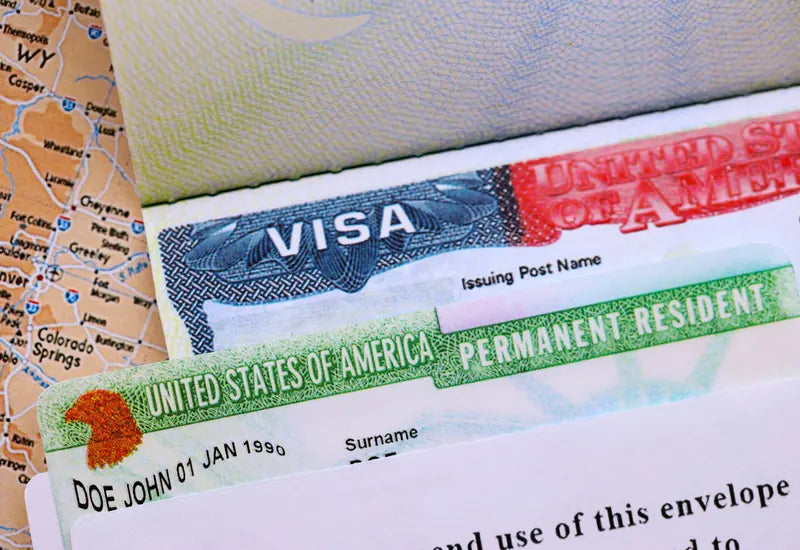
The EB-2 National Interest Waiver (NIW) is a U.S. green card you apply for yourself. You don't need a job offer, an employer sponsor or PERM labor certification. You qualify if you hold an advanced degree or have exceptional ability, and if you can show three things: your specific planned work matters nationally, you are well placed to carry it out, and waiving the job offer benefits the United States.
Key takeaways
- No employer needed. You file Form I-140 for yourself, from inside or outside the U.S.
- USCIS uses the three-part Dhanasar test. It isn't enough that your field is important. What you plan to do has to be.
- Under a USCIS policy effective August 5, 2026, USCIS may deny a petition without first sending a Request for Evidence if required initial evidence is missing or the petition doesn't establish eligibility. USCIS expects eligibility to be shown at the time of filing.
- For a self-petitioner filing on paper, the I-140 government fees are $1,015 ($715 filing fee plus a $300 Asylum Program Fee). The online I-140 filing fee is lower. Optional premium processing adds $2,965.
- Pakistan and most countries fall under "Rest of World." In November 2026 the EB-2 Final Action Date for them is April 1, 2025. Applicants born in India and China wait much longer.
What is the EB-2 NIW?
Almost every employment-based green card starts with a U.S. employer. That employer first has to go through PERM labor certification, which means proving to the Department of Labor that no qualified American worker is available for the job. The process is slow and expensive, and it ties you to that one employer until your green card comes through.
The National Interest Waiver skips both steps. U.S. immigration law lets USCIS waive the job offer and labor certification requirement when doing so is in the national interest. Because no employer is involved, you can act as both the petitioner and the beneficiary. In other words, you sponsor yourself.
At our Karachi office, one question comes up almost every week: "Can I get an American green card without a job offer?" The NIW is one possible route, but it doesn't suit every profile. This guide explains the general requirements. It can't assess your individual case.
| Regular EB-2 (PERM) | EB-2 NIW | |
|---|---|---|
| Job offer | Required | Not required |
| PERM labor certification | Required, and often takes a long time (see DOL processing times) | Waived |
| Who files | The U.S. employer | You (or an employer, if you prefer) |
| Tied to one employer? | Yes, until the green card | No, you're tied to your proposed endeavor |
| Can you file from abroad? | Only with a U.S. employer | Yes |
Step 1: Qualify for EB-2 itself
Before USCIS considers the national interest at all, it checks whether you qualify for the EB-2 category itself. The January 2025 USCIS guidance made it clear that this is a separate threshold question. If this baseline isn't met, USCIS cannot approve the NIW request. There are three ways in:
- Advanced degree. A U.S. master's degree or higher, or a foreign degree that's equivalent to one.
- Bachelor's degree plus five years of progressive experience. This means a U.S. bachelor's degree (or foreign equivalent) followed by at least five years of experience in your specialty where your responsibilities grew over time.
-
Exceptional ability in the sciences, arts or business. To use this route you must meet at least three of these six criteria:
- A degree, diploma or certificate in your area of exceptional ability.
- Letters from employers showing at least 10 years of full-time experience in the field.
- A license or certification to practice your profession.
- A salary or other pay that shows exceptional ability.
- Membership in professional associations.
- Recognition for your achievements from peers, government bodies or professional organizations.
Step 2: Pass the Matter of Dhanasar test
Since 2016, USCIS has decided NIW cases using the three-part test from Matter of Dhanasar. You must satisfy all three parts. USCIS looks at your evidence as a whole, so strength in one area can help another. However, each of the three parts must be met. We break each part down in our full guide, Matter of Dhanasar explained.
Merit and national importance
What you plan to do in the U.S. has real value, and its impact reaches beyond your own employer or clients.
Well positioned
Your education, track record, plan and progress so far make you credible to carry it out.
Balance favours a waiver
On balance, the U.S. gains more by letting you go ahead now than by making you go through PERM.
Prong 1: Substantial merit and national importance
The key phrase here is proposed endeavor. This means the specific work you will do in the United States, not your job title and not your field in general. Merit can come from science, technology, health, education, business, entrepreneurship or culture. National importance is about the wider impact your work could have. For example, it might advance a field, create jobs (especially in economically depressed areas), or support a national priority.
The 2025 guidance is blunt on one point: showing that your profession is important doesn't prove that your endeavor is nationally important.
Prong 2: Well positioned to advance the endeavor
USCIS looks at your education, skills and knowledge, your record of success in similar work, whether you have a plan, the progress you've already made, and interest from potential users, customers, investors or partners. You don't have to prove you will definitely succeed. You do have to show you're a credible person to carry out this plan.
Recommendation letters and business plans help, but USCIS now expects them to be backed by independent, objective evidence. Examples include publications and citations, patents, contracts, revenue, funding, adoption of your work by others, and media coverage. A glowing letter with nothing behind it carries little weight.
Prong 3: On balance, the waiver benefits the U.S.
Here you explain why making you go through the normal job-offer route would cost the country something. Factors that help:
- A job offer or PERM would be impractical, for example because you're a founder or self-employed.
- The U.S. would benefit from your work even if qualified U.S. workers are available.
- Your work is urgent, for example in public health, national security or critical technologies.
- Your work has the potential to create jobs or attract investment.
What changed in 2025 and 2026 (and why old advice can hurt you)
A lot of NIW content online is two or three years old. These changes matter:
- January 15, 2025: NIW policy update. USCIS updated its Policy Manual. It confirmed that EB-2 eligibility is checked first, that the general importance of a field isn't enough, that letters and plans need corroboration, and that STEM work and critical and emerging technologies can weigh in your favour. It also confirmed that entrepreneurs can qualify. Read our breakdown: what the 2025 update changed.
- March 1, 2026: premium processing went up. The fee for an I-140 rose from $2,805 to $2,965.
- August 5, 2026: denials without warning. Policy Alert PA-2026-05 confirmed that officers may, in their discretion, deny a petition without first issuing a Request for Evidence (RFE) or Notice of Intent to Deny (NOID). This applies when required initial evidence is missing or the petition doesn't show eligibility. The familiar 12-week RFE window is now a maximum, and shorter deadlines are possible. The extra 14 days USCIS used to allow for notices mailed overseas has been removed, which directly affects applicants in Pakistan. The policy applies to requests pending or filed on or after August 5, 2026.
EB-2 NIW evidence checklist
Every case is different, but petitions commonly include the documents below. For the full version, with an example for each item, see our complete NIW evidence checklist.
To prove EB-2 eligibility
- Degree certificates and transcripts, with a credential evaluation for foreign degrees
- Experience letters on company letterhead, with dates, duties and full-time status
- Professional licenses and memberships, if relevant
To define and support your endeavor
- A clear proposed-endeavor statement covering what you will do, where and for whom
- A business plan if you're a founder, with numbers you can back up
- Government or industry data showing the national need your work addresses
To prove your track record
- Publications, citations, patents, products or completed projects
- Proof of impact: adoption of your work by others, contracts, revenue, funding, grants or awards
- Media coverage, invitations to speak, or experience reviewing or judging others' work
Third-party support
- Recommendation letters, ideally including experts who know your work but haven't worked with you
- Letters of interest from U.S. organizations, investors, clients or collaborators
Filing paperwork
- Form I-140 and the correct fees (plus Form I-907 if you want premium processing)
- Passport bio page
- Certified English translations of any document that isn't in English
How to file EB-2 NIW, step by step
- Review the requirements. Understand the EB-2 eligibility rules and the three Dhanasar prongs.
- Define your proposed endeavor in one or two clear sentences. Everything else in the petition is built around this.
- Collect the evidence and order your credential evaluation and translations early. These two steps often cause delays.
- Secure recommendation letters. Each one should be specific and different, and should describe the impact of your work rather than just praise you.
- Write the petition letter. This is the cover brief that walks the officer through each requirement and points to the exact exhibit that proves it.
- File Form I-140 with the fees, and Form I-907 if you want premium processing. The date USCIS receives your petition becomes your priority date.
- After approval, once your priority date is current, apply for the green card. If you're in the U.S. you file Form I-485 (adjustment of status). If you're abroad you go through the National Visa Center and a consulate interview (consular processing).
For more detail, read how to file EB-2 NIW step by step.
How much does EB-2 NIW cost in 2026?
| Item | Government fee | Notes |
|---|---|---|
| Form I-140 filing fee | $715 | Required |
| Asylum Program Fee (self-petitioner) | $300 | Required. Most employers with more than 25 U.S. employees pay $600. Nonprofits pay $0. |
| Premium processing (Form I-907) | $2,965 | Optional. USCIS takes action (approval, denial, RFE or NOID) within 45 business days for NIW |
| Form I-485 (if you're in the U.S.) | $1,440 per applicant age 14+ (paper; $950 under 14 filing with a parent) | Paid at the green card stage |
| Consular processing (if you're abroad) | State Dept immigrant visa fee plus $235 USCIS Immigrant Fee | See travel.state.gov fees |
On top of these you'll pay for the credential evaluation, translations, medical exam, police certificates and any professional fees. USCIS fees change, so always confirm on the official USCIS fee schedule (G-1055) before you pay. A wrong fee can get your whole packet rejected. For more detail, see our full EB-2 NIW cost breakdown.
EB-2 NIW timeline and the Visa Bulletin
There are two separate clocks:
- The I-140 decision. Standard processing takes many months and varies by service center. You can check the current figures on USCIS processing times. With premium processing, USCIS takes adjudicative action (an approval, denial, RFE or NOID) on an NIW I-140 within 45 business days.
- The wait for a visa number. Only a limited number of EB-2 green cards are issued each year, with per-country limits. You can't get the green card until the State Department's monthly Visa Bulletin reaches your priority date.
| EB-2 (incl. NIW), November 2026 | Final Action Date | Date for Filing |
|---|---|---|
| Rest of World (incl. Pakistan) | April 1, 2025 | March 15, 2026 |
| China | October 1, 2021 | January 1, 2023 |
| India | November 1, 2013 | January 15, 2015 |
For November 2026, USCIS is letting applicants inside the U.S. use the Date for Filing chart for employment-based adjustment of status. Your chargeability is normally based on your country of birth, not your citizenship. That's why someone born in India but holding another country's passport still faces the India backlog. Learn how to read these charts in our guide, the Visa Bulletin explained.
EB-2 NIW vs EB-1A vs PERM
| EB-2 NIW | EB-1A | EB-2 / EB-3 PERM | |
|---|---|---|---|
| Self-petition | Yes | Yes | No |
| Core standard | Advanced degree or exceptional ability, plus national interest | Extraordinary ability, top of your field | Job offer and labor certification |
| Evidence bar | High | Very high | Moderate, but employer-driven |
| Visa backlog | EB-2 queue | Usually shorter (EB-1) | EB-2 or EB-3 queue |
Some applicants file both NIW and EB-1A. See EB-2 NIW vs EB-1A for how the two compare.
7 common weaknesses in NIW petitions
- Describing your field instead of your endeavor. "AI is important" proves nothing about you.
- Template letters. Five letters with the same phrasing tell the officer that you wrote them yourself.
- Big numbers, no proof. A business plan that projects 200 jobs with no funding, customers or track record behind it gets little weight.
- A shaky EB-2 base. If your degree doesn't evaluate the way you assumed, the petition may not meet the EB-2 requirement.
- Missing initial evidence. Since August 2026, missing translations or documents can lead to a straight denial.
- An endeavor that doesn't match your history. If you propose work you've never done before, you'll struggle on prong 2.
- Filing too early. A rushed petition just to secure a priority date is riskier than it has ever been.
See every common reason for denial in top reasons EB-2 NIW petitions get denied.
A worked example: the same engineer, two petitions
This is a composite example based on the kinds of profiles we review. It isn't a specific client.
Hamza is a mechanical engineer from Karachi. He has a four-year BE, a master's degree and nine years designing HVAC energy-efficiency systems for commercial buildings.
Version one says Hamza is an experienced engineer and the U.S. needs engineers. It includes three letters from former managers and his degree certificates. This version would likely struggle on prong 1, because it describes a profession rather than an endeavor.
Version two defines the endeavor: designing and deploying energy-recovery retrofits for older U.S. commercial buildings, tied to federal building-efficiency goals. It backs this up with:
- measured energy savings from projects he has completed
- a published case study
- two letters from independent engineers who adopted his method
- letters of interest from two U.S. facilities firms
- U.S. government data on building energy use
Hamza is the same person in both versions. What changes is how clearly the petition addresses each requirement. The outcome always rests with USCIS.
Is EB-2 NIW right for you? A quick self-check
- Do you hold a master's degree, or a bachelor's degree plus five years of growing experience?
- Can you describe in one sentence the specific work you'll do in the U.S.?
- Does that work affect more than just your own employer or clients?
- Do you have proof, beyond your CV, that you've already made an impact in this area?
- Would at least two independent experts vouch for your work?
These questions reflect the general requirements. They can't tell you whether you qualify.
Request a free consultation
Tell us about your background and plans, and we'll explain how our preparation services work. We are consultants, not attorneys. Where legal advice or an eligibility opinion is needed, we connect you with a licensed attorney. Consultations are available in English, Urdu and other languages.
Request a free consultation WhatsApp usEB-2 NIW: frequently asked questions
Can I apply for EB-2 NIW without a job offer?
Yes. That's the main advantage of the NIW. You can file Form I-140 for yourself, with no U.S. employer and no PERM labor certification, as long as you meet the EB-2 requirements and the three-part Dhanasar test.
Can I file EB-2 NIW from Pakistan or another country outside the U.S.?
Yes. You can file the I-140 from abroad. Once it's approved and your priority date is current, you complete the green card process through the National Visa Center and an immigrant visa interview at a U.S. embassy or consulate.
Do I need a PhD or publications to qualify?
No. Many approved NIW applicants are engineers, entrepreneurs, healthcare professionals and other practitioners without a PhD. What matters is a clearly defined endeavor of national importance and independent evidence that you can carry it out. Publications are one type of evidence among many.
How long does EB-2 NIW take in 2026?
With premium processing, USCIS takes adjudicative action (an approval, denial, RFE or NOID) on an NIW I-140 within 45 business days. Standard processing can take many months. After approval you wait for your priority date to become current. In November 2026 the EB-2 Final Action Date for Rest of World applicants is April 1, 2025, and it's far earlier for India and China.
How much does EB-2 NIW cost?
A self-petitioner pays $715 for Form I-140 plus a $300 Asylum Program Fee, which is $1,015 in total. Premium processing is an optional $2,965. The green card stage costs extra: $1,440 per applicant age 14+ (paper; $950 under 14 filing with a parent) for Form I-485 inside the U.S., or the State Dept immigrant visa fee plus the $235 USCIS Immigrant Fee for consular processing (see travel.state.gov fees). Evaluations, translations, medical exams and professional fees are also extra.
Can my spouse and children get green cards too?
Yes. Your spouse and unmarried children under 21 can get green cards as your dependents, using your priority date. If they're in the U.S. and file Form I-485, they can also apply for work and travel permits while the case is pending.
What happens if my NIW petition is denied?
You can file a motion to reopen or reconsider, appeal to the Administrative Appeals Office, or file a new, stronger petition. Since August 5, 2026, USCIS can deny a petition without first sending an RFE.
Can I file EB-2 NIW and EB-1A at the same time?
Yes. They're separate I-140 petitions, and some applicants file both. An approved EB-1A usually brings a shorter wait for a visa number.
Can I change jobs after my NIW is approved?
Generally yes, because the NIW isn't tied to a specific employer. What matters is that you keep pursuing the proposed endeavor described in your petition. USCIS or the consulate may ask about this at the green card stage.
Related EB-2 NIW guides
Official sources
- USCIS Policy Manual, Vol. 6, Part F, Ch. 5: Second Preference (EB-2)
- USCIS: Employment-Based Immigration, Second Preference EB-2
- USCIS Policy Manual, Vol. 1, Part E, Ch. 6: Evidence (updated by PA-2026-05)
- USCIS Fee Schedule (G-1055)
- U.S. Department of State: Visa Bulletin
- USCIS: Check Case Processing Times
Phoenix Immigration Consulting Services LLC is an immigration consulting firm, not a law firm, and does not provide legal advice or representation. This article is general information, accurate as of the date above. Immigration rules, fees and dates change often, so check official USCIS and Department of State sources before acting. No outcome is guaranteed; all decisions rest with USCIS and the U.S. Department of State.
Upload your CV for a free EB-2 NIW assessment and an honest view of your chances.
Phoenix Immigration Consulting Services LLC is an immigration consulting firm, not a law firm, and does not provide legal advice. This article is general information and may change; always confirm current rules on uscis.gov and travel.state.gov.